

Turning up the light to see the darkness
Julia Creuheras
Curated by Aurélien Le Genissel and Karla Siguelnitzky
Julia Creuheras’s exhibition immerses us in a poetic and strange universe, close to science fiction and influenced by quantum mechanics. Drawing inspiration from the idea of a timeless, floating space, Creuheras creates a kind of limbo or in-between space where modern dichotomies—visible/invisible, magical/real, animated/inert—dissolve.
Many of her works, often kinetic sculptures and installations, function as fields of force: objects that are not merely matter but presences that interact and challenge our perception. Her work stages an unstable, ambiguous ontology—somewhere between the living and the non-living—like butterflies that could be toys, models, or trapped insects, or machines that seem to run endlessly on their own.
The artist moves between the conceptual and the sensory, between science and intimate experience. She invites us to inhabit uncertainty and accept that what we do not understand can also be a form of knowledge. As Karen Barad—a key figure in the exhibition—says, “Measuring nothing is like turning on the light to see darkness”: a theoretically impossible but deeply revealing gesture.
Collapsible content
Curated text
The two protagonists are sitting in a 1940s roadside café. They stand up, and "when the curtains are drawn, beyond the window there is only a vast, starry black void. The café seems to be some kind of capsule floating in deep space." This is how Mark Fisher begins his now-classic article The Slow Cancellation of the Future, explaining the final scene of the British series Sapphire and Steel.
I find something of that blend of science fiction, poetry, and strangeness in Julia Creuheras’s universes. A lost room in a parallel or hidden space-time—anachronistic and disorienting—where the familiar blurs, certainties wobble in a precarious balance, absences are loud, and images are inaccessible. More than as a visible reference, science—especially quantum mechanics—serves the artist as a hermeneutic framework, a new sensory paradigm closer to uncertainty, flux, and instability, inheritors of the hybrid and interconnected.
The staging might resemble a field of forces: a space where particle-objects interact with each other from a distance in a nonlinear way. In this way, Creuheras invites us into a sort of limbo, an intermediate space where modern dichotomies like magical/real, visible/invisible, animated/inert, stable/slippery, light/particle blur, stepping with one foot on each side of these differential lines. Creating art from this is her way of embracing the much-needed imaginations about how to coexist.
We perceive this shift of references and scale immediately upon entering the exhibition, where we are welcomed by a single, disproportionately large human presence, turned backward in an enigmatic twist. Meanwhile, music loops from a machine that seems to function on its own. "This is the trap. This is no place, and it is forever," said the characters of Sapphire and Steel before drawing the curtain.
The premises of non-places and liminal spaces are present in some of Creuheras’s sculptures: in the arrangement of 21 heels and shirts that performativize those characters, the marked absence of cushions, or images whose very nature seems to be precisely not to be seen or looked at, despite being made of light—like a kind of impossible biography or inaccessible experience.
If we are talking about blurring boundaries, escaping the "classification vertigos," what better than to imagine an unstable ontology of objects, a soft purgatory where it is easier to "let meaning float" (a beautiful expression by Nastassja Martin)? To make uncertainty, the undecidable, the insoluble, the doubtful, the unstable—all words that come from quantum physics—a gift. Doubt can be a place from which to know. Perhaps in exactly the same sense that Derrida spoke of the ethical imperative as the act of enduring aporia until the very end.
It is no coincidence that the title of this exhibition comes from an antinomic phrase by Karen Barad (a key figure for the artist) explaining how theoretically impossible it is to measure nothing, which would be like turning on the light to see darkness—something paradoxically impossible.
This coexistence of different states is also found in the "devices" Creuheras presents, halfway between robot and the physical contradiction (alive/dead) of Schrödinger’s cat. A kind of Agamben’s Pinocchio in its “undeterminable nature,” that "constitutive indefinition of the puppet’s nature," leaving it somewhere between child and doll. The same goes for the butterflies (plane? toy? model?) Creuheras frames in a transparent box, as if they were experiments or pets.
The hybrid, bastard nature of these kinetic sculptures delves into the dual, almost Frankenstein-like nature of machines and questions empathy—the boundary we set between ourselves and the Other. The same happens with the veils, the strange sway of objects, or the deception of certain translucent materials that prevent us from accessing a complete view (if that even exists...) of the photographs the artist presents. Visibility is no game of chance.
— Aurélien Le Genissel


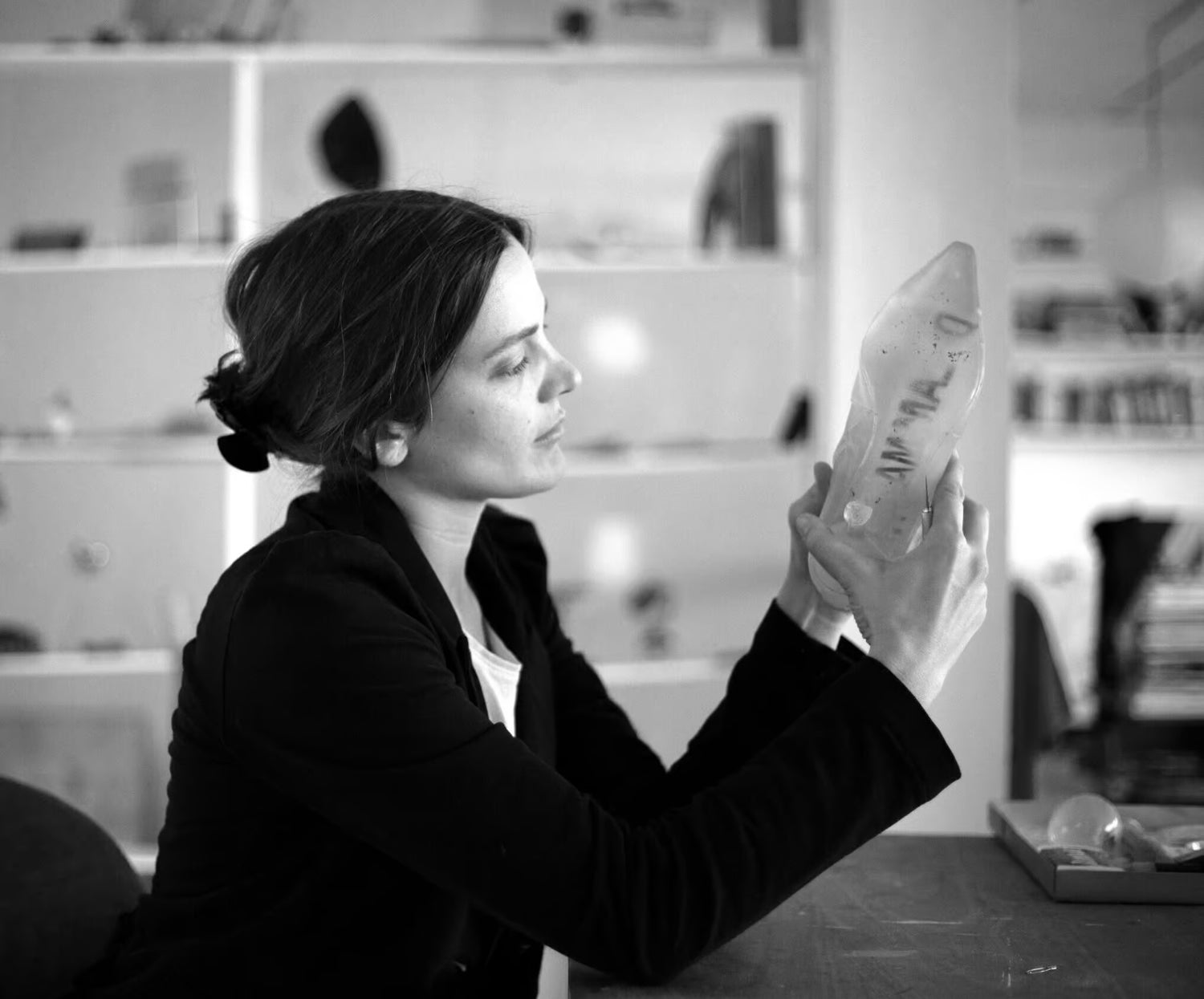
Julia Creuheras
Julia Creuheras (Barcelona, 1995) has developed an artistic practice that combines kinetic sculpture, installation, and textiles, proposing artifacts that evoke both ritual objects and everyday mechanisms overwhelmed by mystery. Her works function as poetic machines that reveal the invisible forces shaping the ordinary, proposing an experience of circular, rhythmic, and suspended time.